Portal | HRM | Email | LMS | Exam | Procedures Manual | Student Exchange | Repository | Research Journal | Jobs | 

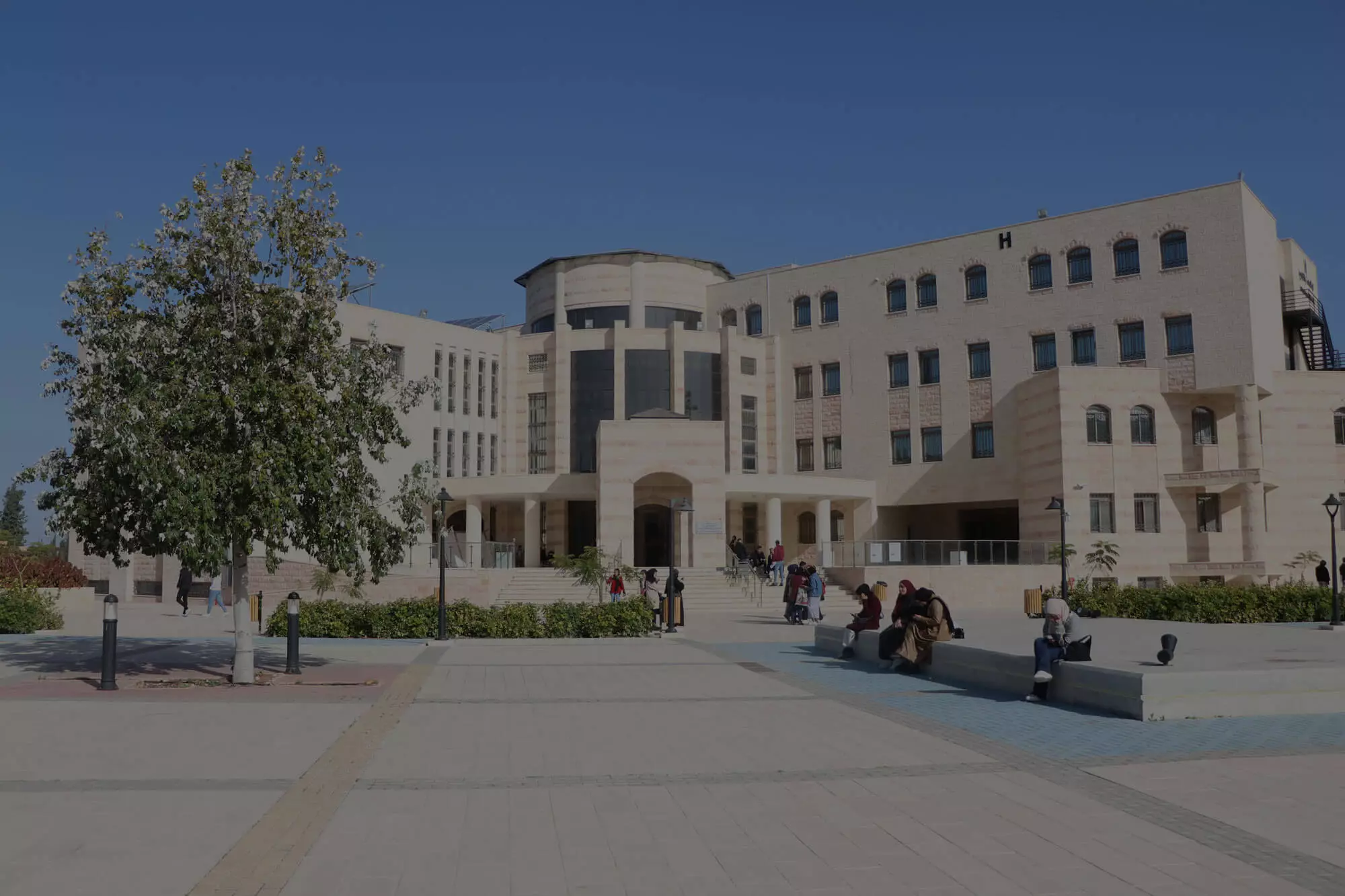
This course aims to consolidate the concept of Islamic culture and introduce students to sound cultural and intellectual concepts regarding the sources of Islam, the Islamic faith and its pillars, and Islamic law, which regulates all aspects of social, economic, and political life. It also clarifies Islam's position on a number of contemporary intellectual issues, as well as identifying the most important challenges facing Islam and its culture.
This course is equivalent to three credit hours, two of which are theoretical and one of which is practical. This course addresses the concept of corruption, its forms and definition locally, regionally and internationally, the role of the corruption system in Palestine, and the role of civil society institutions, good governance and local authorities in combating corruption.
The course attempts to develop the students’ basic language skills to help them build up functional vocabulary, expressions and structures used in business contexts. The course is based on a wide range of realistic student-centered communicative challenging and creative activities to enable students to use accurate English in their professions
This course aims to equip students with the necessary skills to write administrative and business correspondence in English.
This course aims to equip learners with the knowledge, skills, and attitudes necessary to work in the field of administrative support, representing the professional qualifications required to perform the job description in this field. This is achieved through an 80-hour training program in a business organization within the Palestinian market, where learners will practice preparing correspondence, scheduling appointments, reception and telephone communications, organizing meetings, handling mail, arranging travel, managing records, processing data and texts, and creating electronic spreadsheets.
The course aims to develop the students’ cognitive abilities and communication skills in Arabic language by introducing Arabic dictionaries, spelling and grammatical errors, and familiarizing them with ancient and modern Arabic literary models including models from the Holy Qur’an.
This course focuses on enabling students to gain a practical and simplified understanding of entrepreneurship. It begins with defining entrepreneurship and its role in society, moves on to identifying personal entrepreneurial traits such as leadership and creativity, and concludes with developing essential skills including time management, decision-making, and problem-solving. Students will explore the nature of small businesses, the characteristics of self-employment, and the key success factors in entrepreneurial ventures, including planning, idea development, and selecting an appropriate business model. The course also covers the preparation of a comprehensive business plan that integrates marketing, pricing, and digital promotion, while providing students with the basics of financial management, cost estimation, and funding methods. Additionally, students will be introduced to topics such as digital transformation, e-commerce, freelancing, and the applications of artificial intelligence in entrepreneurship, with the aim of enhancing their readiness for the modern labor market.
This course aims to provide students with fundamental mathematical knowledge, particularly regarding numbers and operations on them as a general review. It also introduces exponents, their rules, roots, and how to work with them. In addition, the course covers solving quadratic equations using the quadratic formula, solving two linear equations using the elimination and substitution methods, and solving word problems that lead to linear equations. The course also aims to equip students with knowledge related to sets, statements, the counting principle, permutations and combinations, the binomial theorem, arithmetic sequences, finding the sum of a number of their terms, and solving sequence-related equations. Furthermore, the course covers relations and their types, matrices and their operations, and solving linear equations using matrices. The course also aims to introduce students to the laws of probability.
This course aims to equip learners with the knowledge, skills, and attitudes necessary to work in the field of administrative support, representing the professional qualifications required to perform the job duties in this field. This is achieved through an 80-hour training program in a business organization within the Palestinian market, where learners will practice monitoring administrative tasks, coordinating to meet business requirements, using and maintaining office equipment, developing personal skills, preparing reports and statistics, coordinating personnel-related tasks, and utilizing databases and time management software.
A study of the concept of physical education, its objectives, and its relationship to general education. It also introduces the most important skills and basic principles of some team and individual sports, along with the rules of these games. It also covers the conduct of indoor and outdoor matches and activities, training in refereeing matches and activities, and identifying some sports injuries that affect players on and off the field, their causes, symptoms, and first aid methods. This course also covers some athletics competitions and how to organize some sports tournaments.
This course provides a comprehensive introduction to the fundamental principles of accounting as an essential tool for preparing financial reports and analyzing the financial performance of organizations. It aims to enable students to understand the vital role of accounting in the business environment by presenting the theoretical and practical foundations of accounting concepts. The course begins by introducing students to basic accounting concepts such as assets, liabilities, equity, revenues, expenses, and the fundamental accounting assumptions and principles. It covers the accounting cycle in detail, including the analysis of financial transactions, recording journal entries, posting to the ledger, preparing the trial balance, and performing accounting adjustments. The course also addresses the preparation of key financial statements, namely the income statement, balance sheet, and cash flow statement, with an explanation of how to use these statements to evaluate financial performance and make economic decisions.
This course aims to equip students with the necessary skills to prepare archives, preserve documents, and ensure their protection. By the end of the course, students will be able to organize and maintain archives following proper scientific principles, in addition to managing documents as part of an enterprise content management system, including the management of digital assets, scanned documents, and workflow systems.
This course aims to enhance and enrich students’ skills with This course aims to enhance and enrich students' skills with modern information technology concepts, as well as computer and digital device skills, modern computer applications in practical life and the internet, information security concepts, and data analysis. Students apply the concepts and skills they acquire using appropriate software.
This course aims to equip students with the necessary skills to prepare documents and reports containing large amounts of data and information in a concise and well-organized format, highlighting the most important points. This, in turn, helps managers understand what is happening within the organization.
This course provides an introduction to office work, modern trends in office management, and the relationship between the office and other administrative departments. It also covers office buildings and design, along with the physical work environment. The course offers essential knowledge for students aspiring to work in legal support professions, particularly in secretarial and office management roles, as well as in providing administrative support services such as office organization, appointment scheduling, visitor reception, telephone handling, meeting preparation, report writing, interviewing, processing correspondence and mail, typing tasks, and office design and preparation. These skills help save time and effort for managers and enable them to focus on performing their administrative functions.
This course aims to equip students with the necessary skills to manage and track the entire correspondence cycle. It also provides students with skills in using the Internet, email, Outlook, and social media platforms.
This course aims to equip students with the fundamental skills of protocol and ceremonial management in various institutions. Students will learn the rules of conduct, the art of conversation and introductions, and the organization of visits, ceremonies, and receptions. By the end of the course, students will be able to professionally plan, arrange, and prepare visit programs, manage events, and draft all types of invitations and official correspondences.
This course aims to equip students with the necessary skills to write administrative and business correspondence in Arabic.
This course tackles the nature of business administration, management theories, planning, organization, communication, negotiation, leadership, motivation, decision-making, control, and enterprise functions. The course is blended and delivered using lectures, field visits, workshops, report writing, e-learning, case studies and group discussions.
This course aims to equip students with the necessary skills to create and design informational databases using Excel and Access. Students will learn to prepare and design databases containing structured tables, as well as to create queries, reports, and interactive forms that facilitate the process of data retrieval and management.
This course aims to equip students with skills in Publisher, Photoshop, and PowerPoint. Students will learn to type and edit text, insert objects such as graphics, images, icons, and auto-shapes, and manage presentations by creating slideshows with appropriate timing, suitable backgrounds, and professional navigation between slides. They will also master inserting images, audio, and video. Additionally, students will learn the theoretical and practical principles of digital images, digital image creation, and gain an in-depth understanding of colors, their theories, and how to choose the correct color system. This knowledge enables students to create impressive graphics and stunning designs using the latest version of Photoshop.
This course aims to introduce students to the basics of Arabic typing and train them to type Arabic texts on the computer using the touch-typing method (without looking at the keyboard), at a speed of no less than 40 words per minute and an accuracy of no less than 98%, free of errors and with high precision. The course focuses on helping students memorize the positions of letters on the keyboard, in addition to developing their typing skills and reinforcing their practice in both daily and professional life through exercises and lessons, whether using typing programs or word-processing software such as MS Word.
This course generally aims to develop students' major and minor English language skills. It provides students with a variety of linguistic patterns, different grammar patterns, grammatical structures, and common words and definitions. These, when acquired, enable students to communicate meaningfully in general and everyday situations. The course is geared toward equipping students with the skills they need to comprehend texts, contexts, and situations related to everyday life. Throughout the course, students will be exposed to a variety of listening approaches to expand and deepen their listening comprehension and critical thinking skills. Students are expected to acquire the skills necessary to express their opinions on everyday topics and problems, both orally and in writing, thus broadening their academic horizons.
This course focuses on providing students with the fundamentals of public relations, including its concept, development, and importance. It also introduces students to the objectives of public relations, its position within the organizational structure of an institution, and the essential qualities required of a public relations practitioner. The course covers an introduction to public relations, as well as methods of communication and interaction among the parties involved. Additionally, it presents the competencies learners are expected to acquire in managing public relations.
This course focuses on providing students with an understanding of the concept of a system and its components, as well as the general characteristics that distinguish systems and their classifications. The course covers the general framework of Management Information Systems (MIS) and their importance, in addition to offering a comprehensive description of the stages involved in building and developing management information systems.